
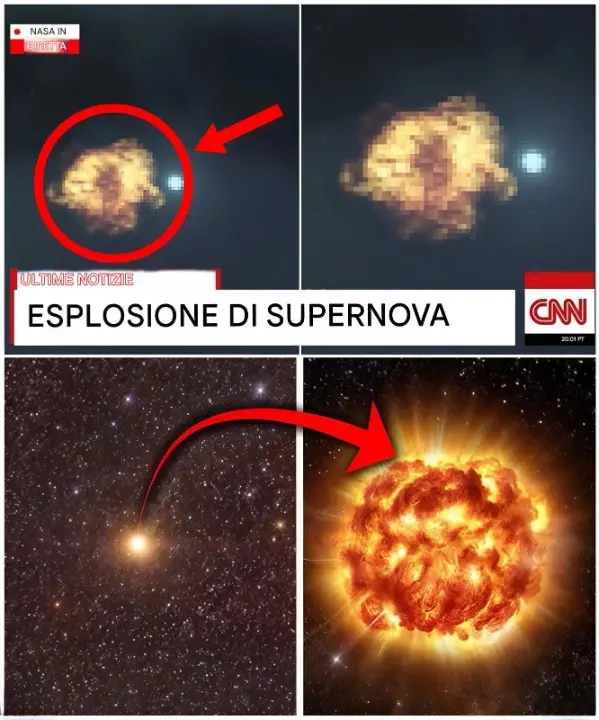
The James Webb Space Telescope, often called JWST or simply Webb, has revolutionized our view of the cosmos since its launch. This powerful instrument peers deep into space using infrared light, allowing scientists to observe distant galaxies, forming stars, and mysterious phenomena hidden by dust. Among the many targets it has studied is Betelgeuse, one of the most famous stars visible from Earth. Betelgeuse sits prominently in the constellation Orion as a bright reddish point, drawing attention from both professional astronomers and casual skywatchers for decades due to its dramatic variability and enormous size.
Betelgeuse is classified as a red supergiant, a massive star nearing the end of its life cycle after burning through its nuclear fuel at an accelerated rate compared to smaller stars like our Sun. These supergiants expand dramatically, sometimes reaching sizes that would engulf the orbits of inner planets if placed in our solar system. Betelgeuse measures hundreds of times the diameter of the Sun, making it one of the largest known stars observable without advanced equipment.
Its surface temperature is relatively cool for a star, around 3,500 Kelvin, which gives it the characteristic red hue that makes it stand out in the night sky.
Astronomers have long monitored Betelgeuse because of its unpredictable brightness changes, which have sparked speculation about an impending supernova explosion. In late 2019 and early 2020, the star experienced the so-called Great Dimming Event, where it faded by up to 60 percent over several months. This unusual behavior led some to wonder if it signaled the final stages before collapse. However, detailed studies later attributed the dimming primarily to massive dust clouds ejected from the star, blocking light rather than indicating core instability at that moment.
Such events highlight how complex and dynamic these massive stars can be throughout their evolution.
Recent viral claims suggest that NASA’s James Webb Space Telescope has captured Betelgeuse in its “final moments,” showing a chilling cosmic death spiral with unexplained thermal signatures, violent surface disruptions, and strange light fluctuations. These headlines describe urgent closed-door meetings among astronomers and hints of instability deep in the star’s core. Social media posts and sensational videos amplify the idea that Betelgeuse is on the brink of exploding as a supernova, potentially visible as a dramatic event in our skies. The phrasing implies a groundbreaking revelation that could alter our understanding of stellar death.
However, credible scientific sources from NASA, the Hubble Space Telescope team, and peer-reviewed publications tell a different story about Betelgeuse’s current status. In early 2026, astronomers announced the discovery of a hidden companion star orbiting Betelgeuse, nicknamed Siwarha. This smaller companion creates a visible wake of dense gas as it plows through the supergiant’s extended atmosphere. Observations from Hubble and ground-based telescopes over nearly eight years confirmed this binary nature, explaining some of the star’s peculiar brightness variations and atmospheric disturbances without pointing to imminent collapse.

The companion’s orbital period of about 2,170 days influences Betelgeuse’s behavior significantly. When Siwarha passes in front or behind the primary star from our viewpoint, it causes measurable changes in spectral lines and gas outflows. This interaction may contribute to mass ejections and pulsations, but it pushes estimates for any supernova far into the future. Experts now suggest Betelgeuse remains stable for at least tens of thousands to hundreds of thousands of years, possibly even longer due to the binary dynamics. No official NASA release in 2026 confirms JWST capturing “final moments” or a death spiral leading to immediate explosion.
James Webb has indeed observed red supergiants and supernova progenitors, providing unprecedented infrared detail. For instance, in late 2025, JWST identified a dust-cloaked red supergiant just before it exploded as SN2025pht in galaxy NGC 1637. This marked the telescope’s first direct detection of such a progenitor at mid-infrared wavelengths, solving puzzles about why massive supergiants sometimes seem missing in surveys. These observations help refine models of how stars like Betelgeuse evolve, but they apply to distant events, not our nearby neighbor in Orion.
Betelgeuse lies approximately 640 light-years from Earth, close enough that a supernova would appear extraordinarily bright, potentially rivaling the full moon for weeks and visible even during daytime. The explosion would release neutrinos, gamma rays, and heavy elements forged in the core, enriching the interstellar medium for future star formation. While harmless to life on Earth due to distance, the event would captivate global observers and provide a rare natural laboratory for studying core-collapse supernovae up close. Predictions remain uncertain because stellar interiors are difficult to probe directly.
The hype around “final moments” often stems from misinterpretations of ongoing monitoring data or exaggerated social media content. YouTube videos and Facebook posts with dramatic titles claim JWST images show unprecedented instability, yet no matching peer-reviewed papers or NASA statements support an imminent supernova in 2026. Instead, recent JWST contributions to Betelgeuse studies focus on refining atmospheric models, dust composition, and companion effects rather than confirming a death spiral. Astronomers emphasize patience, as massive stars evolve slowly on human timescales.

Understanding Betelgeuse requires combining data from multiple observatories. Hubble has tracked ultraviolet emissions and companion wakes, while ground telescopes measure radial velocity shifts. JWST excels at piercing dust to reveal cooler regions and molecular features in the star’s outer layers. These complementary views build a comprehensive picture of a volatile yet enduring supergiant. The discovery of Siwarha adds complexity, suggesting binary interactions play a larger role in variability than previously thought, potentially delaying core collapse.
Supernovae from red supergiants like Betelgeuse are Type II events, characterized by hydrogen-rich spectra and dramatic light curves. Historical examples, such as SN 1987A in the Large Magellanic Cloud, provided invaluable insights despite occurring in a different environment. If Betelgeuse explodes, modern instruments including JWST, Hubble successors, and neutrino detectors would capture every phase in exquisite detail. Until then, the star serves as a living example of late-stage stellar evolution, pulsing and shedding material in cycles that challenge theoretical models.
The fascination with Betelgeuse extends beyond science into culture and mythology. Named from Arabic roots meaning “armpit of the giant,” it features in ancient stories across civilizations. Its reddish appearance inspired tales of omens or divine signs. Today, online communities track its brightness obsessively, sharing light curves and comparisons to past dimming events. This public engagement drives interest in astronomy, encouraging people to look up and appreciate the dynamic universe overhead.
Sensational claims about cosmic events often spread rapidly because they tap into awe and fear of the unknown. A star exploding nearby evokes both wonder and existential questions about our place in the cosmos. Responsible reporting distinguishes between verified discoveries and speculative interpretations. In Betelgeuse’s case, the evidence points to continued observation rather than catastrophe. Scientists urge calm, focusing on incremental advances that deepen knowledge without alarmism.
Future observations will clarify more about Betelgeuse’s fate. Planned Hubble returns in 2027 when the companion emerges again promise fresh data on orbital dynamics and atmospheric impacts. JWST may conduct targeted infrared campaigns to map surface features or detect pre-supernova neutrinos if conditions align. These efforts ensure we remain prepared for whatever surprises this enigmatic star reveals next.
In summary, while the James Webb Space Telescope continues to deliver stunning insights into stellar phenomena, including red supergiants, no confirmed evidence supports claims of capturing Betelgeuse’s “final moments” in a death spiral. The star remains a fascinating, variable giant with a newly confirmed companion influencing its behavior. Its eventual supernova will be spectacular when it arrives, but timelines stretch far beyond current predictions. Astronomy thrives on rigorous data and patient study, turning viral speculation into solid understanding over time. Betelgeuse reminds us of the universe’s vast timescales and the beauty of ongoing discovery right in our galactic neighborhood.